So, speaking of dangerous art, your chance to run with scissors is here now!
I can't think of anything much more dangerous than:
-Dabbling in the arena of propaganda
-Commodifying your art by seeking a cash prize
-Juxtaposing your faith with your politics
The Art of Politics political poster contest caught my eye recently. I checked out the entries so far, and was saddened by the majority of them. I asked, is this really the length and depth of our country's political conversation and creativity? Surely, it cannot be. I tried really, really hard to think of what I would make, and I came up more cynicism. See?
So, the question is, can you do what I cannot? It will involve conversing with a crowd that perhaps you feel no sympathy for. You may need to walk where your art angels fear to tread. You may not want to trifle with this, because you belong to a greater Kingdom. Or, you may feel burned by politicians who have used your Good Lord's name to gain political power. I challenge you, if you feel so superior, to please enlighten the masses.
What we're looking for:
-Neither cynicism nor fideism.
-Concensus building rather than polarization.
-Forward thinking; not wallowing in the past.
My pet project, Click Patron, is sponsoring a bonus competition to the Art of Politics 2008 poster contest. That means you enter their contest, and once you let Click Patron know, you're entered into a bonus competition. The grand prize is $200! Find out the gory details here.
Click Patron's mission is to encourage emerging artists with cash assistance among other things.
Showing posts with label visual art. Show all posts
Showing posts with label visual art. Show all posts
Friday, March 7, 2008

Wednesday, February 27, 2008
Dangerous Art

The following is an article from David Taylor, the Austin-based playwright and pastor who is speaking at our Artists' Retreat in April. He is doing some research for a symposium on the theme of art and danger and would love to get some feedback from you guys so all his information isn't coming from the South. You can reply by commenting directly on his blog at http://artspastor.blogspot.com/2008/02/nasty-ghastly-dark-disturbing-dangers.html or by commenting here and beginning a conversation with our readers and contributors. We're really looking forward to getting to know David and his wife in April.
I am beginning my research for my talk at the symposium. My given title is: What are the dangers of artistic activity? and I would covet your opinions and perspectives. Here are a few areas for exploration.
1. Think of your personal experience. What experiences of art for you have been negative or destructive or debilitating or stifling or confusing?
2. Think of your church setting. What are dangers in high church settings and in the low church settings? High art practices and pop art practices?
3. Think of sins of commission and omission. In what ways are dangers things done or things left undone? In what ways is a danger a "too much" or a "too little"?
4. Think of cultural and societal patterns. In the advance and proliferation of media technologies, how are the arts being enlisted to serve ends that do not contribute to the well-being of humans or communities or cities?
5. Think of the artist and the audience. What are dangers peculiar to the artist, separate from the work? What are dangers peculiar to an audience--from a mass audience to a select audience?
Think whatever you want. All I care is to hear what you think are dangers--past dangers, present dangers, future dangers, actual dangers, potential dangers, fantasy dangers, small and big, yours and theirs.
Lastly, for fun, in addition to any of your observed dangers, tell me a way in which you might become the one to produce something dangerous; and by dangerous I don't mean daring, prophetic, "people just aren't ready for me yet" kind of dangerous art, I mean good old fashioned, "produced by a fallen creature" dangerous art.
David Taylor blogs at http://artspastor.blogspot.com
Sunday, February 24, 2008
The Cobalt Season comes to Portland

So I sat down to write this review because one of my favorite music groups is coming to town this week, and I wanted to pimp the show. How’s that for shameless? Here goes: San Francisco-based Indie Art Folksters, The Cobalt Season will be playing at Enterbeing Thursday night, February 28.
Who is The Cobalt Season, you might ask. I figured someone wouldn’t be in the know, so when I started considering how I would go about prostituting their music ("pimping"? "prostituting"? alright, this motif has to end), I thought I would just throw out some links to other online reviews and call it a post. In my review-writing laziness, I came across something interesting; I discovered it’s impossible to describe an artist without comparing them to someone else. Have you ever noticed that? Brian McLaren, compared TCS to the Weepies and Sigur Ros, among others. Mark Van Steenwyk likens them to the Arcade Fire and Copy (I don’t see that connection myself, but, to each his own). Had I to do it, my instincts call to Iron and Wine, a dash of Sufjan Stevens, and perhaps a less ambiguously enunciated Thom Yorke. But you can hop on iTunes and draw your own conclusions.
The musical styling isn’t the only reason you should check out The Cobalt Season; their live performance is compelling and provocative (ok, that’s a third racy-descriptor, but this one is not gratuitous). The front man, Ryan Sharp delves into critical issues of faith and living, and doesn’t settle for the cliché-ed, quick answers. As many of the live performances I have seen have been in small faith communities, often connected with Emergent Village, prepare to sit on a pillow and engage in some story-telling and culture prodding.
I’m not familiar with Enterbeing myself (the venue/community hosting the event), but the show is at 7pm and you can find out more about The Cobalt Season at www.thecobaltseason.com.
Glenn Krake writes sporadically for the ImagoDeiArts blog when he's not browsing iTunes for artists that sound like Martin Sexton.
Wednesday, February 20, 2008
A Name Inflames

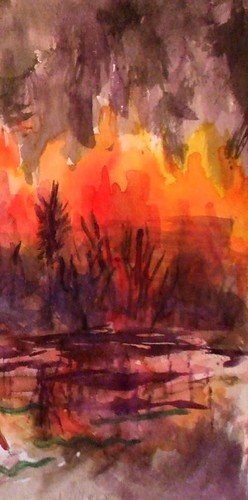
"A name inflames peoples' ideas and expectations. It's a cultural defect" Jonathan Shahn, sculptor and son of Ben Shahn.
For a year, my family and I made and displayed our art under the pseudonym, Saint Anonymous. It was an experiment with a few key goals. I wanted to be immersed in an atmosphere that nurtured a purer form of worship. I wanted to make collaboration a priority. I wanted to save my family--but that's another blog post.
The main tenet of Saint Anonymous was pure worship. It wasn't until the Renaissance that artists began signing their work. Before then, artists who made works for the church were not interested in defacing the pieces offered to God with their signatures. Considering this, when contemporary artists make worshipful pieces, I wondered if it is indeed a pure offering if we are signing our work. It's kind of like saying, "Here God, this is the very best I have to offer to You, but HEY PEOPLE, I've made a false idol of needing your approval and affirmations, too." Aside from casting down idols, I figured that our narcissistic MySpace profile-building generation needed a dose of humble anonymity to be mystified by. You see, when we come together to worship the Lord, all eyes should be on Jesus, but we are too easily distracted by our own creativity, our fellow worshipers, brand-name preachers, and denominational awareness. So, showing my family's art, which we make as an act of worship to our Creator, seemed best done in anonymity (at least it did at the time). We wanted to draw the viewer in to sharing our worship of God, and help them to not consider us, the sub-creators, as a factor in their worship.
We had a month-long solo exhibition under the nom de couleur of Saint Anonymous. It was an uncomfortable experience. We were invited to a celebration of the show, and drove 7 hours over to Nampa, Idaho so that we could pretend to not be the artists who made the work. There were lots of questions about the pieces, with nobody to ask. It became a game for the students to find out who Saint Anonymous was. They speculated preposterous notions about the art into the air, hoping to see if there was a troubled reaction on anybody's face. I struggled with casually milling around the gallery and not engaging with their quandary. I wanted to strip away identity from ourselves in order to more purely worship God, but I was finding that the side effects of our experiment were alienation and misunderstanding from the rest of society, who seemed unable to connect with the work that had no identifiable maker.
This experiment led me to ask a key question: what is more pleasing to God? "Pure" worship that causes isolation and confusion? Or messy, communal worship that leads to reconciliation and truth? I came to the conclusion that the identity of the artist is essential for the work to build community, and as you guessed, I am certain that God desires unity far more than well-intended, but alienating praise.
The quotation at the beginning of this post is from Jonathan Shahn, a sculptor. He has some gripes with critics who can't resist comparing his work to his father's. I agree with the intent of his sentiment, but I suppose he's going to have some more gripes, because I've included his words so that I could take them out of context.
"A name inflames people's ideas and expectations."
Imagine if God came not in the form of Jesus Christ, the human, but as an unknown property of physics such as anti-gravity. We certainly would take notice when, let's say, the toilet starts flushing backwards, but then, we also would feel no relationship or emotional bond to it. We might feel fear for sure, and quite possibly the shame of soiled clothing, but it would be hard to love even if "it" might be our Creator demanding our attention. Once Adam died, humanity lost firsthand knowledge of what it is like to walk with God in the cool of the morning. We were alienated from our Creator and His art. It is hard to deny the existence of God when we are awed at the complexity and order of the macro and micro universe, or when our guts get all tingly at seeing a beautiful sunset, but this amounts to anonymous, unrelatable majesty. It is art that we cannot connect to because we don’t know the Maker. It leaves us confused and isolated. We don't know how we relate to this creation, and we feel so skeptical about people who claim that they do. We loathe those people speculating wild notions into the air about religion and God, and we detest it to the point of proposing back that there is no Artist, this gallery, and the work inside of it, came into being on their own.
I've often asked the question, "Why Jesus?". Why this scheme of an Only Son, a blood sacrifice, an all-powerful God in a helpless baby's body at the mercy of His own creation? Maybe you've come to your own conclusions about this. Here are some of mine. I think that this Creator recognized that we could not know Him unless we raised Him as our own. We had no reason to believe Him when He said that His creation was good, until He proved it, and placed Himself in the care of it. We could not appreciate and be unified by the art until the Artist ripped open the curtains of anonymity. Of course, that was 2,000 years ago that Jesus walked among us with as normal and unassuming a name as Josh might be today. But, this face in the crowd was also the face man for God the Artist, and has left a growing and indelible mark on society. His name has not faded away and it truly inflames ideas and expectations. Just like most artists, He suffers through misinterpretations and fallacies about His work, but the power and essence of His work is His name, His identity as the Son of God and the Son of Man. He is a reference point, juxtaposing humanity with their Creator. God's face is no longer unknown to us, and through our relationship with His Son, we too, should no longer feel anonymous.
--
Christopher Dennis heads up his family’s art blog, Dennis Family Art Collective, and is the founder of Click Patron, an organization whose goal is to provide cash assistance to emerging artists.
Image: Detail from Blue Heron Foils Snake's Plans For The Valley
Wednesday, February 13, 2008
Timmerman’s Condensed Art History

There is no better way to spend a rainy Tuesday evening than engaging in a ninety minute dash through a history of art and the Church. Beginning at the year dot with a few paintings of Christ the Good Shepherd on tomb walls, Tim Timmerman, (Director of Art at George Fox University,) guided us through almost two thousand years of art-steeped history without drawing breath. Having passed quickly over the whole fine art arena to land on music and literature as my own particular comfort foods I was fascinated to find out a little more about the progression of visual art throughout the last two thousand years, the developing role of the artist and the Church’s, oftentimes unwieldy hand, in the whole process.
Timmerman is an excellent communicator with a wealth of fascinating little asides which punctuated his lecture and allowed us all to take something home to mull over at the end of the evening. Personally I loved his section on Gothic art and architecture and was really convicted to discover that many of the great architects who began the construction of elaborate Gothic Cathedrals and Churches fully realized they would not live to see their work completed and would pass this privilege on to their children and grandchildren. This knowledge coupled with Timmerman’s stories of intricately carved capstones and bricks placed eighty foot above eye level really convicted the artist in me to create art and beauty for the glory of God, with the kind of humility that does not need gratification from critics or fans. Throughout the evening we were offered many similar nuggets. I could hear people scribbling notes and anecdotes into journals all around the room and hope to see some of these quiky little stories popping up in our art over the next few months.
By the end of the evening I was almost overwhelmed by the amount of information which had passed between my ears. I had a file page full of artist’s names I plan to check out and investigate a little further and a healthy appreciation for the artists who have come before us. Surely this kind of awareness of art’s progression through the ages, (the artists who have struggled, locked heads with the church, been misunderstood and highly acclaimed, wrestled their own faith and art, failed,learned and soldiered on,) can only make us thankful to have a small place in such a rich tradition of people who have presented a God-drenched sense of beauty and truth to the unbelieving masses. I know that I left the lecture last night, freshly inspired to create, to strive towards innovation in my work, to anticipate struggle and failure but ultimately to know that God has throughout history used and continues to use the Artist as His hands and feet, His canvas and pen to scratch His kingdom into the four corners of the World.
Tim Timmerman lectures at George Fox University. Keep watching the website and mailing list for upcoming Imago Arts lectures.
Jan Carson blogs at http://specialfriends7.blogspot.com
Subscribe to:
Comments (Atom)